
Stoicism has had a remarkable revival in recent decades. You’ll find Marcus Aurelius on the bookshelves of CEOs and in the reading lists of elite athletes; Seneca quoted in productivity podcasts; Epictetus cited by cognitive therapists. Most people encounter the Stoic virtues — courage, temperance, wisdom, justice — as ideas to aspire to, principles to internalise through reading and reflection.
I’ve been lucky. I found a place to practise them with my body.
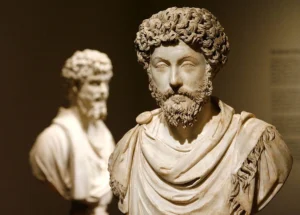
What I want to argue here is not simply that Ki Aikido and Stoicism share surface similarities — they do, and I’ll show you — but that each tradition completes something the other leaves open. Stoicism, for all its practical wisdom, has always been a largely interior discipline. Its virtues are cultivated in the mind, tested in the world, but rarely given a structured physical form. Aikido, by contrast, makes the virtues tangible: you cannot fake centredness when someone is gripping your wrist. Together, these two traditions describe the same ideal of the good human being — one in ancient Greek and Latin, the other in movement and breath.
If that claim sounds overstated, read on. I’ll try to earn it.
Courage
Courage — or, in Ki Aikido terms, performing with confidence — is foundational to everything that happens on the mat. You cannot blend with an attack you are fleeing from. You cannot relax into a throw you are bracing against. Before any technique is possible, something more basic is required: the willingness to turn and meet.
Many beginners don’t feel that willingness at first. They arrive with a version of themselves already full of objections:
- I’m not strong enough…
- I’m too old…
- Too young…
- Too big…
- Too small…
- Too uncoordinated…
- I can’t…
I was no different. But the critical inner voice has quietened as I’ve progressed, and I’ve noticed something: it has quietened off the mat too. The confidence that comes from meeting a larger partner without clashing, from staying centred when you expected to panic — that capacity doesn’t stay in the dojo. It travels.
Seneca understood this mechanism precisely. Hardship, he argued, is not the enemy of the good life; it is the condition for it. Without genuine resistance, you never meet the deeper parts of yourself. In On Providence, he wrote:
You are unfortunate in my judgement, for you have never been unfortunate. You have passed through life with no antagonist; no one will know what you were capable of, not even yourself.
Koichi Tohei said something structurally identical from the other direction. In Ki in Daily Life, he writes that a calm, positive mind is not something you are born with — it is something you develop precisely by being tested. Training is not separate from life; it is a compressed version of it, a place where the challenges come reliably and the lessons accumulate faster.
Both men are saying the same thing: the obstacle is not an interruption to your development. It is your development.
Temperance
Discipline. Self-control. The willingness to put in the hours on something that will not yield quickly. These are familiar to anyone who has spent time on the mat, and they are exactly what the Stoics meant by temperance — not abstinence or austerity, but the steady application of effort in the right direction.
Ki Aikido demands this almost perversely. It is easy to learn and fiendishly difficult to master. The principles are simple enough to explain to a child: relax, extend ki, keep one-point, maintain a positive mind. The application of those principles under pressure — when someone twice your size is moving fast, when you are tired, when you have just made the same mistake for the twentieth time — is the work of years. And the art functions at its very best when it appears effortless, which means that all the visible effort is, in some sense, invisible evidence of temperance.
Marcus Aurelius, who wrote the Meditations entirely for himself — not for publication, not for posterity, but as a daily discipline of self-examination — would have recognised this dynamic. The obstacle on the path becomes the way, he wrote. Not around it. Not through it by force. The obstacle is the way.
The same point is made through technique. In Ki Aikido, the goal is never to overpower an attack. It is to receive the attacker’s energy, stay centred, and redirect. That requires not doing something — not clashing, not stiffening, not matching force with force. The non-fighting mind, as Tohei described it, is an achievement of temperance: the self-control required to not react the way every instinct is telling you to.
This is worth its weight in gold both on the mat and off it. Road rage, a difficult colleague, a provocative email — the ability to pause before responding is not a passive quality. It is an active one, trained over time.
Wisdom
You cannot learn that which you think you already know.
In his Discourses, Epictetus — a freed slave who became one of the most influential philosophers of the ancient world — said this as a warning against the complacency of expertise. The most dangerous student is the one who arrives already certain.
In Ki Aikido, this danger is especially real. The media is saturated with depictions of martial arts — the explosive violence, the decisive strike, the dominant fighter — and these images create expectations that have almost nothing to do with what happens in a good dojo. Students who arrive already knowing what martial arts should look like often have more to unlearn than beginners who arrive simply curious.
The Japanese tradition has an answer to this, and it is deeply Stoic in spirit: shoshin, beginner’s mind. It doesn’t mean ignorance; it means sustained openness — the discipline of continuing to investigate rather than concluding. Even the popular idea of a black belt as expertise is, on examination, a misunderstanding. The Japanese word for the first level of black belt (shodan) means beginner level. The colour signals not mastery, but readiness to begin in earnest.
O-Sensei Morihei Ueshiba, the founder of Aikido, practised well into his eighties and is reported to have said that he was still learning — that each day revealed something the day before had hidden. This is not false modesty. It is the natural consequence of a practice deep enough that the more you know, the more you understand you do not know.
Epictetus would have approved. True wisdom, for both traditions, is not an accumulation of answers. It is the cultivation of a certain quality of questioning — the willingness to be wrong, to look again, to keep the glass empty.
Justice
Here I want to be honest about a tension.
The Stoic virtue of justice was, in its original form, explicitly civic. It was about duty to society, about standing up for what is right even at personal cost. Seneca was exiled for opposing the emperor Caligula. Cato chose death rather than submission to Caesar. When Marcus Aurelius wrote about justice, he was thinking about his obligations as emperor — the use of power in service of those he governed. This is a demanding and politically charged concept, not easily mapped onto an evening’s practice in a local dojo.
So let me argue the connection honestly rather than paper over the gap.
What Aikido offers in this space is something different in scale but not in kind. The principle at the heart of Aikido is musubi — connection, union, harmony. Where most martial arts are premised on defeating an opponent, Aikido is premised on resolving conflict in a way that is safe for everyone involved, including the attacker. You join with the attack rather than opposing it. You move their mind rather than their body.
Ueshiba was explicit that this had wider implications. “The Way of Harmony does not exist to fight with and defeat the enemy,” he wrote. “It exists to use the power of love to bring the world into harmony and make human beings one family.” This is, admittedly, a grander claim than anything in tonight’s class — but the impulse behind it is genuinely Stoic. You cannot control what other people do. You can control your response. And a response that seeks resolution rather than domination is, in the long run, of more use to society than one that does not.
Marcus Aurelius, who ruled an empire and faced constant provocation, kept reminding himself of exactly this:
It’s silly to try to escape other people’s faults. They are inescapable. Just try to escape your own.
Power that turns inward, that holds itself to account — that is what justice looks like in practice, whether you are an emperor or a white belt.
A Difference Worth Naming
I have been arguing for similarities, and I believe they are real. But one important difference deserves its own paragraph rather than being glossed over.
Stoicism, at its core, is a solitary practice. You can read Marcus Aurelius alone. You can practise the dichotomy of control — Epictetus’s central tool — alone on a train, in a waiting room, in a difficult meeting. The virtues are cultivated in the mind, and the mind is sovereign.
Aikido is irreducibly relational. You cannot do it alone. Every technique requires a partner — an uke who attacks, a nage who receives. The virtues are tested not in private reflection but in physical, present contact with another person who may be bigger, faster, or more experienced than you. You cannot philosophise your way through a committed attack. Either the centredness is there or it isn’t.
I think this is what makes the combination of the two traditions so valuable rather than merely interesting. Stoicism gives you the philosophy; Aikido gives you the test. One tells you what to aim for; the other shows you whether you’ve actually got there. Together, they offer something neither provides alone: a practice of the virtues that is both interior and embodied, both reflective and immediate.
The Virtues Made Physical
Stoicism has endured for more than two thousand years because it describes something real: the human capacity to choose how we meet whatever life brings. Courage, temperance, wisdom, justice — these are not ideals too lofty for daily life. They are, if anything, more relevant to daily life than to philosophy seminars.
Ki Aikido, for me, has been a way to practise them rather than just admire them.
If you have ever wanted to understand what Stoic virtue feels like from the inside — not as an idea but as a physical state, as something you can locate in your own body under pressure — I would invite you to find a mat, bow in, and begin. You will not look graceful at first. Some days nothing will work. But when it does, and you can feel what centredness actually means in the moment someone is testing it, you will understand something that no amount of reading could have given you.
Marcus Aurelius, Epictetus, and Seneca knew what they were training for. I think, if they were alive today, they would want to know how it feels.
There is only one way to find out.
Elkie Dolling
Chesham (White Hill) Ki-Aikido Club